|
|
|
Home Base: Sevierville, TN
Operation: Central and Eastern USA
Model: P-47D-40RA
Wing Span: 40' 9"
Length: 36' 1"
Height: 12' 6"
Max Speed: 426 mph
Gross Weight: 17,500 lbs
Power Plant: Pratt & Whitney R-2800-59
Horsepower: 2,000
Fuel Capacity: 305 gallons
Armament: 8 x .50 caliber machine guns.
|
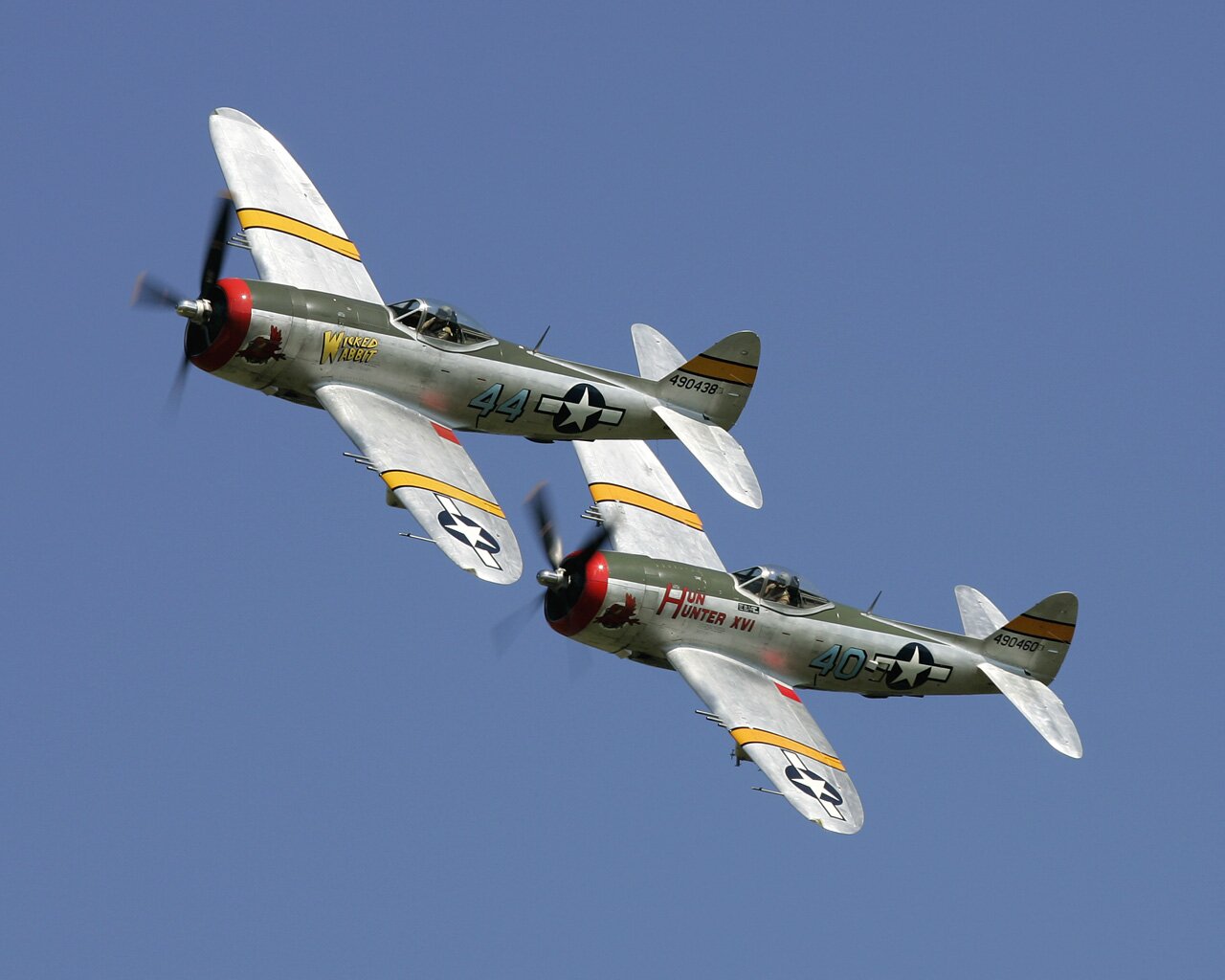
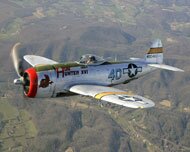
Neal Melton's Republic P-47D Thunderbolt "Hun Hunter XVI"

Neal Melton is the owner and operator of this warbird, which is on display year-round at the Tennessee Museum of Aviation at Sevierville, TN, just east of Knoxville.
Both Neal Melton's P-47D Thunderbolt "Hun Hunter XVI" and John Shoffner's P-47D "Wicked Wabbit" are based at the museum and regularly fly at airshows as a two-ship formation or they can be requested separately for airshows, flybys and film.
The P-47 was the largest single engine fighter of WWII. It has eight .50 caliber Browning machine guns and nearly 3000 rounds of ammo.
Affectionately nicknamed "The Jug," the P-47 was one of the most famous US Army Air Force (USAAF) fighter planes of WWII. Although originally conceived as a lightweight interceptor, the P-47 developed as a heavyweight fighter and made its first flight on May 6, 1941. The first production model was delivered to the USAAF in March 1942, and in April 1943 the Thunderbolt flew its first combat mission, a sweep over Western Europe. Used as both a high-altitude escort fighter and a low-level fighter-bomber, the P-47 quickly gained a reputation for ruggedness. Its sturdy construction and air-cooled radial engine enabled the Thunderbolt to absorb severe battle damage and keep flying.
Using the Jug as a fighter-bomber came about when pilots, returning from escort missions deep inside of Germany, would attack targets of opportunity on there way home. The P-47 gradually became the USAAF's best fighter-bomber, carrying 500 lb bombs, the triple-tube M-8 4.5 inch rocket launcher, and eventually HVARs (High Velocity Ariel Rockets). In this role it destroyed thousands of tanks, locomotives, parked aircraft, and tens of thousand of trucks and other vehicles. With eight .50 caliber machine guns, the only targets truly safe from the Jug's guns
were the heavy tanks and ships; and on those, the P-47 rained bombs and rockets.
Production P-47B, -C, early -D and -G series aircraft were built with metal-framed "greenhouse" type cockpit canopies. Late -D series (dash 25 and later) aircraft and all -M and -N series production aircraft were given clear "bubble" canopies, which gave the pilot improved rearward vision.
During WWII, the P-47 served in almost every active war theater and in the forces of several Allied nations. By the end of WWII, more than 15,600 Thunderbolts had been built, making it one of the most heavily produced fighter aircraft in history.
Only about 10 to 12 P-47’s remain flying today in the world. This aircraft is one of only two P-47D's which have a functioning turbo-supercharger installed. The paint scheme "HUN HUNTER XVI" was that of Gil O. Wymond of the 57th Fighter Group, 65th Squadron.
Photo Gallery
Contact
|
Tennessee Museum of Aviation
135 Air Museum Way
Sevierville, TN 37862
Toll Free: (866) AV MUSEUM (286-8738)
Local: (865) 908-0171
Fax: (865) 908-8421
|

|
|
Please fill out your contact information below if you are interested in contacting the operator, or representative,
of this Warbird and you require more information for booking this aircraft at your Airshow or Event.
|
|


![[Warbird Depot Home Page]](/images/header_2a.jpg)