|

|
|
Home Base:
Camarillo, CA
Operation: Western, Central and Eastern
USA
Model: F6F-5
Wing Span: 42' 10"
Length: 33' 7"
Height: 13' 1"
Max Speed: 430 knots
Gross Weight: 12,186 lbs
Power Plant: Pratt & Whitney R-2800-10
Double Wasp two-row radial
Horsepower: 2,000
Fuel Capacity: 250 gallons
Armament: 6 x .50 caliber machine guns.
Underwing attachments for six rockets.
Centre-section pylons for up to 2,000 lb of
bombs.
|
CAF
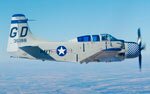
Southern California Wing's Grumman F6F-5 Hellcat "Minsi
III"

The Southern California Wing of the Commemorative
Air Force is the operator of this
Grumman F6F-5 Hellcat "Minsi III"
which is on display in
Camarillo, CA. and is available for airshows,
flybys and film throughout the USA.
Months before the outbreak of the war in the Pacific,
the Grumman company began formal development of a bigger
and better successor to the company's excellent F4F
Wildcat fighter. The result, the "F6F Hellcat", proved
to be everything expected of it, being powerful, rugged,
easy to build and fly, and proving a major player in the
defeat of Japan.
Feedback from the British, then flying the Wildcat
against the Nazis, and from the US Navy suggested that a
more powerful engine was required. The design team, led
by Dick Hutton and under the overall direction of
vice-president of engineering Bill Schwendler, settled
on the Pratt & Whitney (P&W) R-2800 Double Wasp, an
air-cooled, two-row, 18-cylinder radial engine in the
1,500 kW (2,000 HP) class. The R-2800 was also planned
to power both the Republic P-47 Thunderbolt and the
Vought F4U Corsair fighters, but both of these machines
had been delayed, and so Grumman was able to get their
hands on R-2800 production.
Production began at a new Grumman plant in Bethpage,
New York, with the fighter going down the assembly line
before the buildings were completed. The first
production F6F-3 performed its initial flight on 3
October 1942, and service deliveries of the type began
in early 1943. Following carrier trials, in March 1943
the type reached operational status with Navy fighter
squadron VF-9 on the carrier USS ESSEX, with the
aircraft painted Navy blue topside and white on the
bottom, the standard color scheme for the fighter
through the war. Within nine months of the first flight
of the production machine, 15 squadrons were equipped
with the type. The Hellcat was primarily a Navy machine,
the Marines generally preferring the more formidable,
but demanding, F4U Corsair.
The Hellcat clearly showed influence from the
Wildcat. Like the Wildcat, the Hellcat was not
elegant, but it was clean, straightforward, and built
very rugged, confirming Grumman's
reputation with pilots as the "Iron Works". The Grumman
motto was: "Make it strong, make it work, make it
simple." Engineers were encouraged to overdesign the
machines, ensuring they exceeded Navy requirements by
what was called a "Schwendler factor". The cockpit was
designed to be the last thing to fail to help make sure
pilots got back home safe.
The Hellcat went into combat in the early fall of
1943, with its first major action in a raid against
Rabaul harbor on New Britain on 5 November 1943. From
that time on, it was a major player in the Pacific naval
campaigns. On 23 November 1943, US Navy F3F-3s tangled
with Japanese Mitsubishi A6M Zero fighters over Tarawa,
with LT-JG Ralph Hanks shooting down five in five
minutes and becoming an "instant ace". The next day the
Yanks and Japanese mixed it up again. The final score of
the two days of fighting was one Hellcat lost and 30
claimed kills on Zeroes.
The Hellcat no doubt came as a nasty surprise to
Japanese pilots, since it looked enough like a Wildcat
to be confused for one at a distance, but was a
substantially more dangerous adversary, every bit as
tough as the Wildcat but faster and more heavily armed.
It was still no match for the Zero in terms of agility
and couldn't out climb the "Zeke", but the Hellcat could
almost always escape by going into a dive. Any competent
Hellcat pilot who understood his machine's advantages
and the Zeke's weaknesses had the upper hand.
The F6F-5 went into service just as the Hellcat
accomplished its greatest feat of arms: the Marianas
Turkey Shoot. On 19 June 1944, US Navy fighters
protecting the US invasion of the Marianas island chain
were challenged by swarms of Imperial Japanese Navy
Zeroes. The Americans claimed 350 kills to a loss of 30
of their own aircraft. It was all but the end of
Imperial Japanese Navy air power, now suppressed by what
the US Navy called the "Big Blue Blanket" of naval air
power. The last of 7,870 F6F-5s was rolled out in
November 1945. As with the F6F-3, production included a
night-fighter variant, the "F6F-5N" with AN/APS-6 radar,
making up 1,435 of the total. Some F6F-5s were also
converted to a photo-reconnaissance variant, the
"F6F-5P". The US Navy and Marine Corps claimed 5,154
kills in the Hellcat during World War II, giving it a
kill ratio of 19:1.
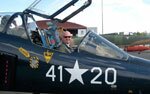
The Southern California's F6F-5 Hellcat is restored
in the markings of Cmdr. David McCampbell, USN, Air
Group Commander of VF-19 on the USS Essex during WWII.
Photo
Gallery
Contact
|
Southern California Wing
455 Aviation Drive
Camarillo, CA 93010
Phone:
(805) 482-0064
Fax: (805) 482-0348
|
|
|
Please fill out your contact information
below if you are interested in contacting
the operator, or representative,
of this Warbird and you require more information for booking this
aircraft at your Airshow
or Event.
|
|


![[Warbird Depot Home Page]](/images/header_2a.jpg)