|

|
|
Home Base:
Greenwood, MS
Operation: Central
and Eastern USA
Model: F4U-5N
Wing Span: 41' 0"
Length: 33' 4"
Height: 14' 9"
Max Speed: 470 mph
Gross Weight: 14,000 lbs
Power Plant: Pratt & Whitney R-2800-32W
Horsepower: 2,459
Fuel Capacity: 363 gallons
Armament: 4 x 20 mm M-3 cannons (Two in
each wing). Could also carry eight 5-inch HVAR
rockets, as well as carry drop tanks, bombs, or
napalm.
|
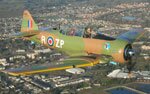
Fighters & Legends Chance Vought F4U-5N Corsair

The Fighters & Legends
is the owner and operator of this Chance Vought
F4U-5N Corsair, which is
available for airshows, flybys, film
and also for a 10-15
minute warbird aerobatic airshow routine.
The F4U Corsair is one of the most famous and
recognizable fighter from WWII, and was the first U.S.
fighter to exceed 400 mph in level flight. The trademark
gull wings are the result of having to place the main
landing gear at the lowest point in the wings to pre
vent the huge 13 foot diameter propeller from hitting
the ground or flight deck on take-off or landing.
The Corsair is popularly known as "The Sweetheart of
the Marianas" and "The Sweetheart of Okinawa" for its
roles in these campaigns respectively - the names were
given by ground troops rather than by naval and marine
personnel. Among pilots, however, the aircraft was
nicknamed "Ensign Eliminator" and "Bent-Wing Eliminator"
because it required many more hours of flight training
to master than other Navy carrier-borne aircraft. It was
also called simply "U-bird" or "Bent Wing Bird."
All warbirds have their own distinctive sounds, and
the Corsair was known to the Japanese on the ground as
"Whistling Death", because of the unique sound generated
by the air flowing over the oil coolers in a dive. The
Marines referred to the Corsair as their best friend for
the excellent air support it provided when troops were
pinned down on the ground. The Corsair was also called
into service during the Korean conflict as an attack and
close air support aircraft.
The Corsair started life as the result of a U.S. Navy
requirement for a carrier aircraft which could match the
performance of the best land and water based fighter
planes. Designed in 1938, the first prototype Corsair
designated XF4U-1 flew in 1940. It was a remarkable
achievement for Vought, as carrier aircraft are,
compared to land-based counterparts, "overbuilt" to
withstand the extreme stress of deck landings.
The Corsair first entered service in 1942. Although
designed as a carrier plane, initial operation from
carrier decks was proving troublesome. The aircraft was
fast and its slow speed handling tricky due to the port
wing stalling before the starboard wing. This, together
with poor visibility over the long nose, made landing a
Corsair on a carrier a difficult task. For these
reasons, most Corsairs initially went to Marine Corp
squadrons who operated off land based runways. The
U.S.M.C. aviators welcomed the Corsair with open arms as
its performance was far superior to the F4F-3 and -4
Wildcat which was being used at that time.
The F4U-5, a 1945 design modification of the F4U-4,
was intended to increase the F4U-4 Corsair's overall
performance and incorporate many Corsair pilots'
suggestions. It featured a more powerful 2,300 hp engine
with a fully automatic two-stage supercharger. Other
"improvements" were electrical trim control, automatic
cowl flaps, a gyroscopic lead-computing gunsight and
other automatic functions. These and other changes made
the F4U-5 500 pounds heavier than the F4U-4.
During the Korean War, the Corsair was used mostly in
the close-support role. As the Corsair moved from its
air superiority role in World War II into the close air
support role in the Korean Conflict, the gull wing
proved to be a useful feature. A straight, low-wing
design would have blocked most of the visibility from
the cockpit toward the ground while in level flight, but
a Corsair pilot could look through a "notch" and get a
better ground reference without having to bank one way
or the other to move the wing out of the way.
The F4U-5N (night fighter conversion of the F4U-5)
logged combat in Korea between 1950 and 1953. There were
dogfights between F4Us and enemy Yak-9 fighters early in
the conflict, but when the enemy introduced the fast
MiG-15 jet fighter the Corsair was outmatched.
Corsair night fighters were used to an extent. The
enemy adopted the tactic of using low-and-slow intruders
to perform night harassment strikes on American forces,
and jet-powered night fighters found catching these "Bedcheck
Charlies" troublesome. U.S. Navy F4U-5Ns were posted to
shore bases to hunt them down.
Fighters & Legends F4U-5N served with the Honduran Air
Force and saw combat in the ground-attack role in 1969
against El Salvador along with 21 other Corsairs. It is
restored in the F4U-5 configuration. Gulled-wings
resulted in shorter and stronger landing gear while a
wide wheel base in combination made the plane more
strong and stable for island and carrier landings. These
characteristics served the Marines and Navy very well.
The Museum's Corsair offers an extremely rare ride in a
WWII Fighter, flown by a Veteran Marine Pilot, that flew
in the Pacific Theatre.
Photo
Gallery
Contact
|
Please fill out your contact information
below if you are interested in contacting
the operator, or representative,
of this Warbird and you require more information for booking this
aircraft at your Airshow
or Event.
|
|


![[Warbird Depot Home Page]](/images/header_2a.jpg)